How a bicycle transforms a city

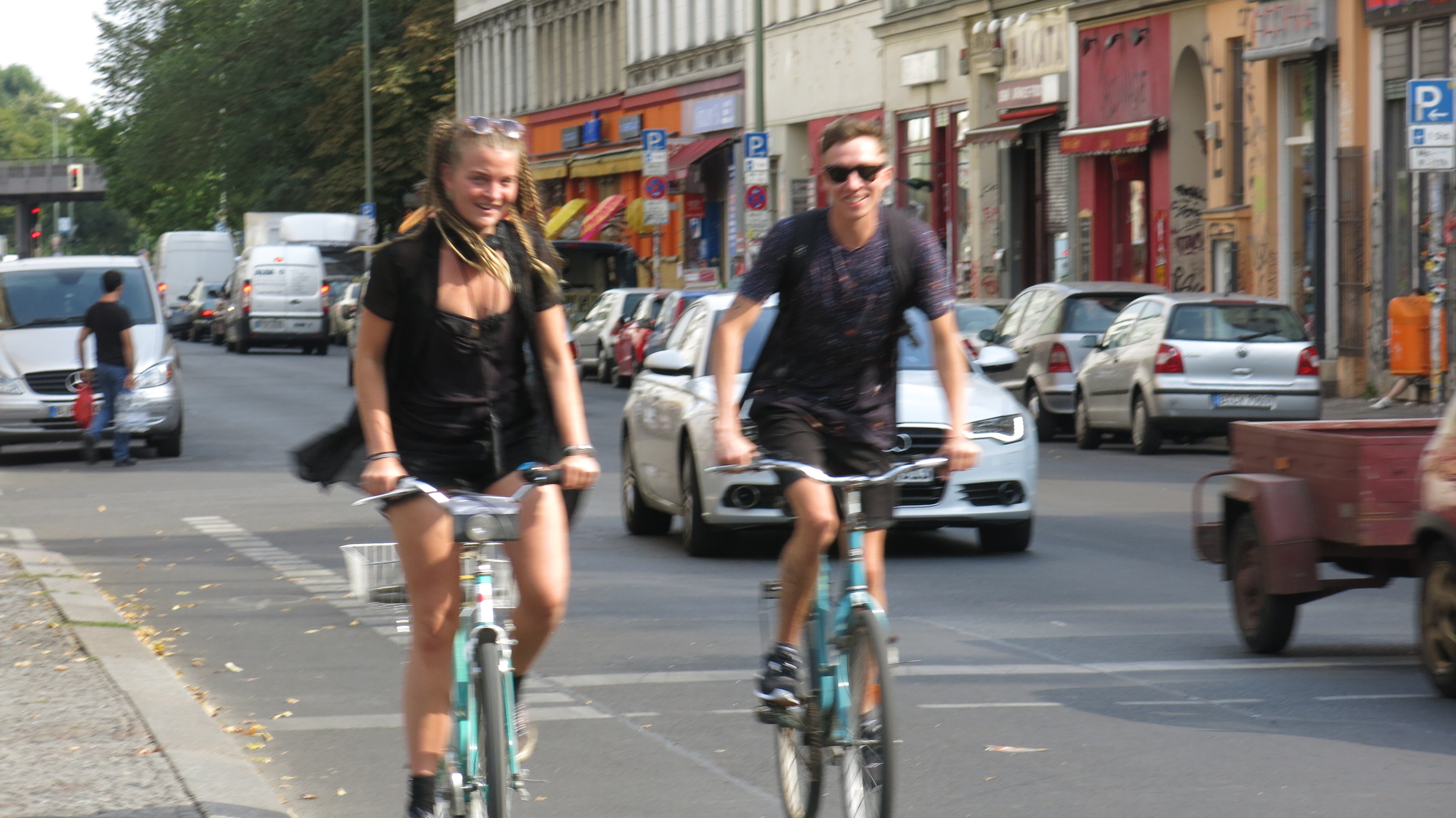
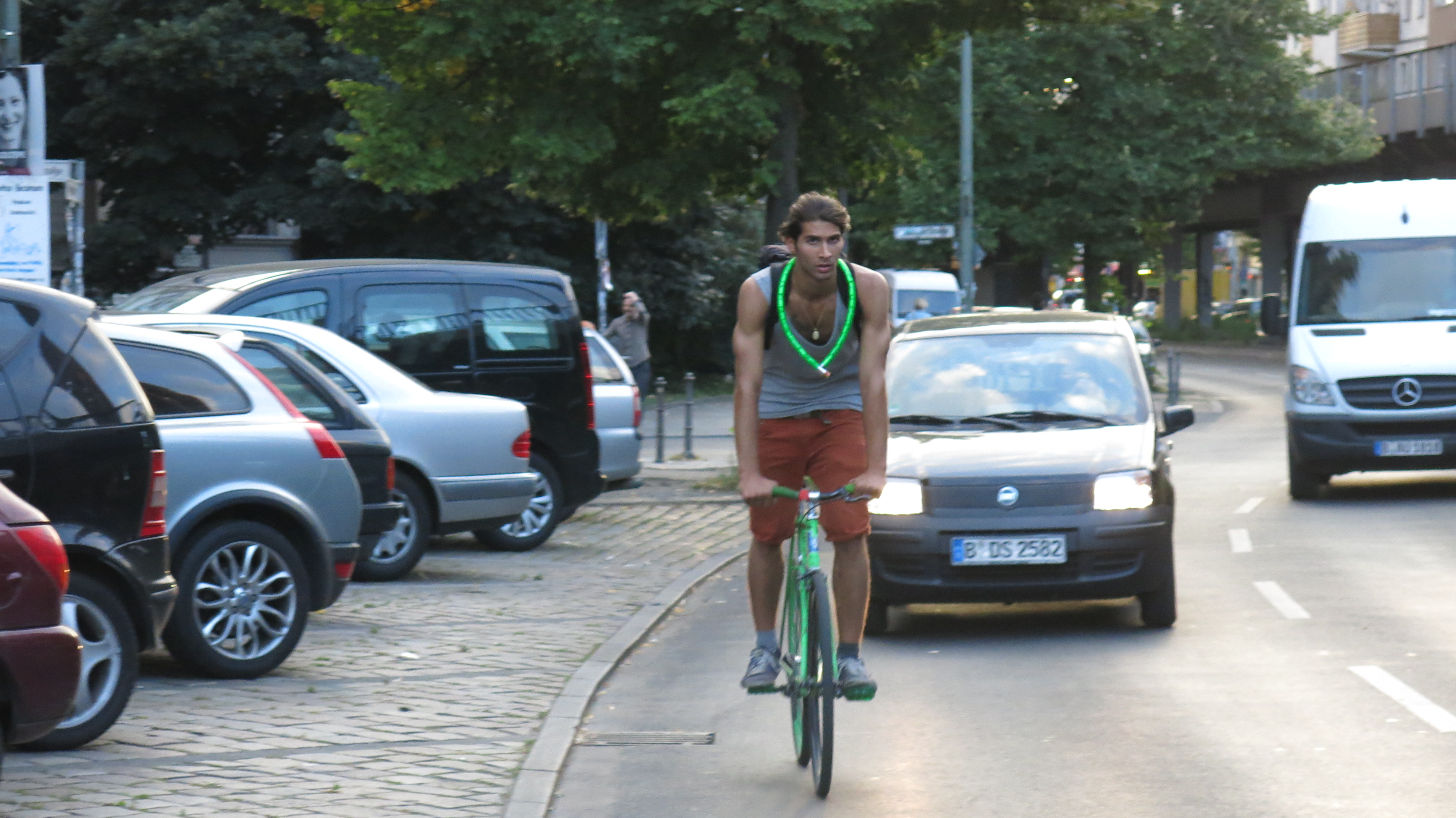
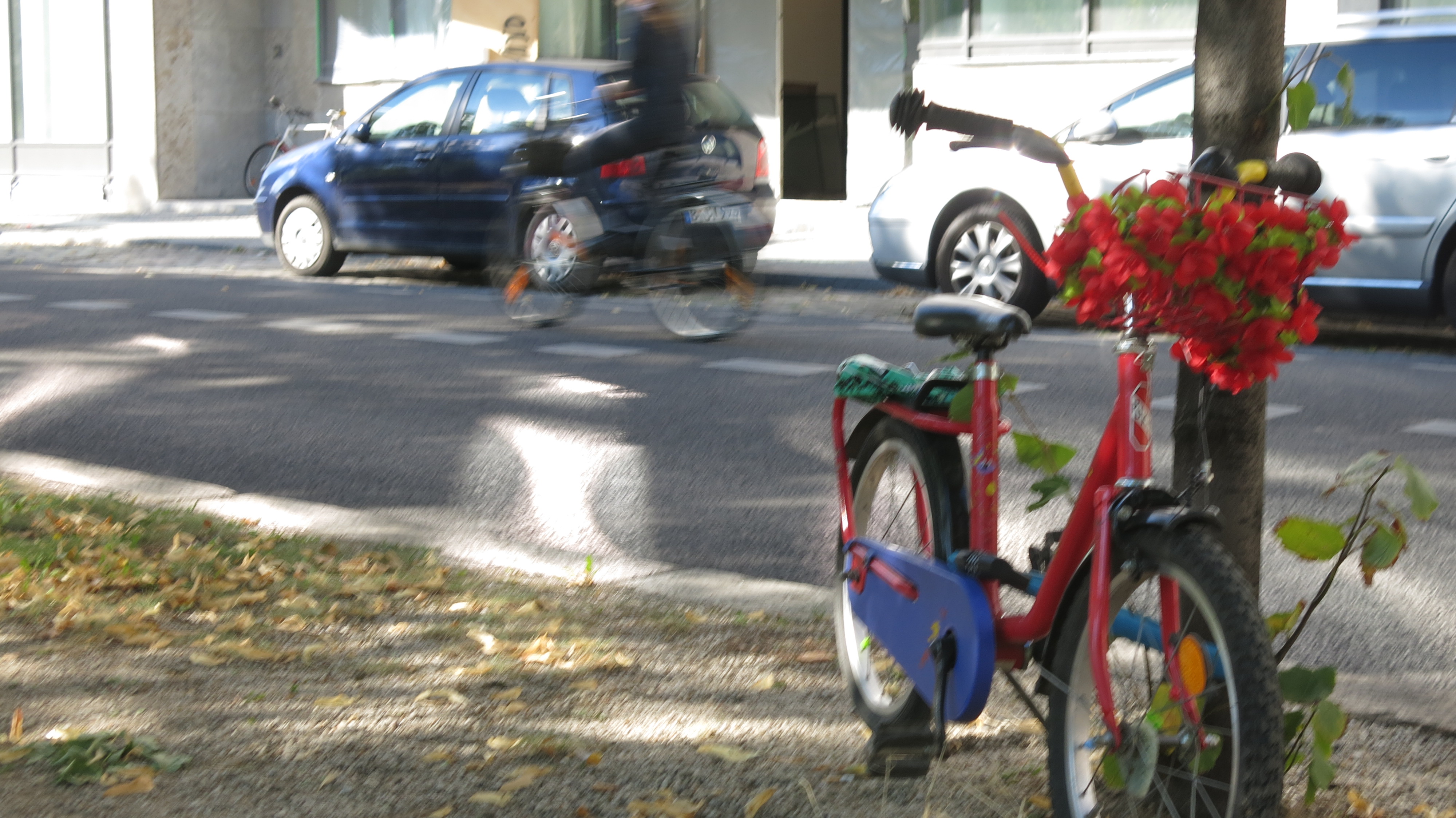
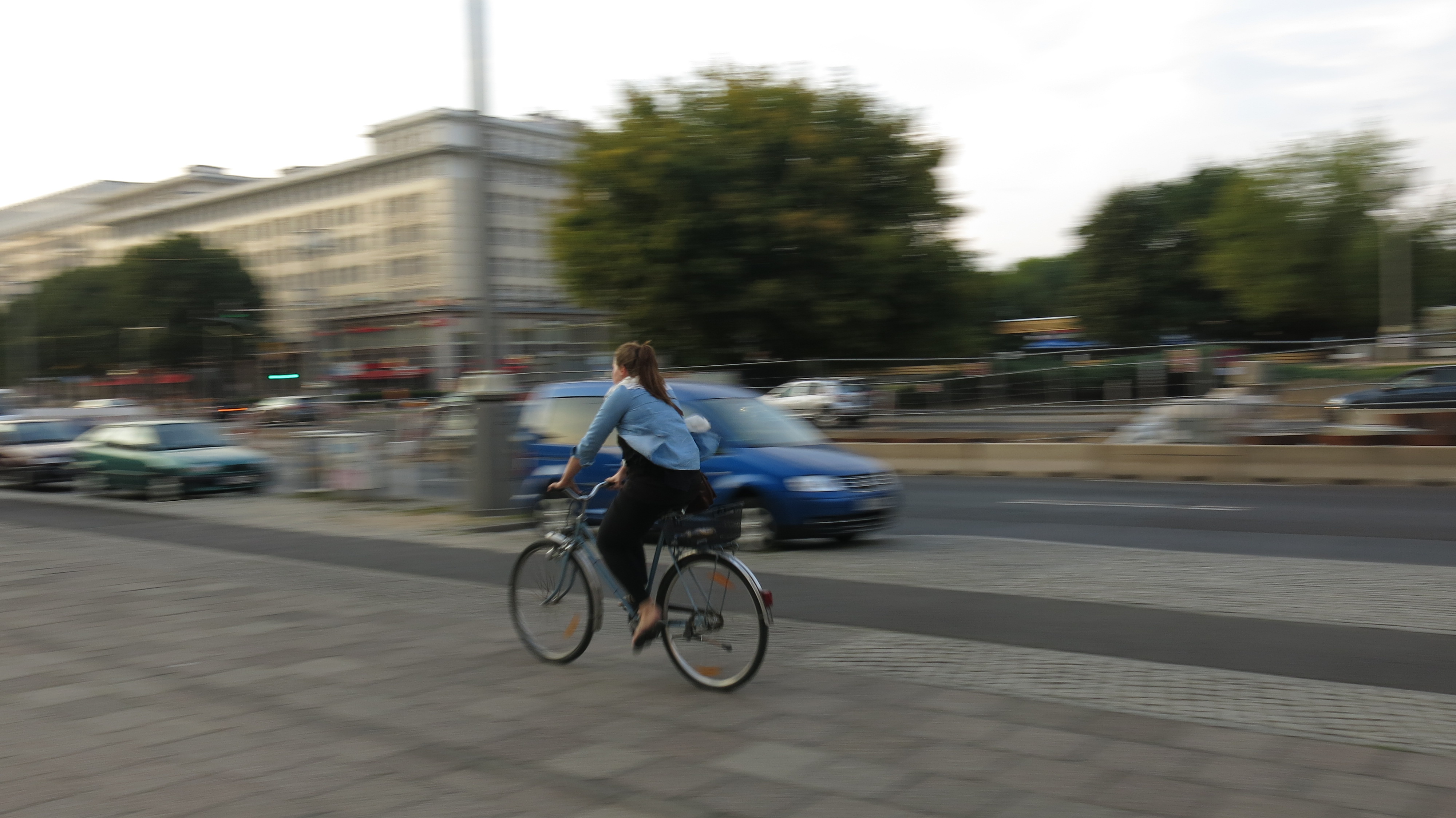
I have spent one bikeless week in berlin and then in the last few days I’ve become all bicycled up.  I am glad I got to spend a week without, in order to see the difference in the feel, the pace and the stimulation of the city.  I suddenly got to play with this city that I’d been taking so seriously.

IMG_0569

On a bicycle I can go from being completely immersed in my surroundings to feeling like I don’t care where I am because I am just having fun in my own little world of movement, rhythm and resistance.  I think this is important, particularly when traveling – when your mind is racing with new stuff to take in and a sense of wanting to make the most of where you are.   You can end up overloading yourself with ideals about where you are and how you should be appreciating it – kind of like when you go to a museum and you feel obliged to spend time to find the beauty and significance of everything you pass.  It can be draining.  I love to be enjoying my ride and then suddenly catch a glimpse of something that takes my breath away.  Luckily on a bicycle you can pull over easily and then spend the time to be awestruck or you can carry on embracing the fleeting moment of beauty you witnessed.

IMG_0544

The city has also opened up to me in other ways.  I feel more like a local for one, because I get the opportunity to ride with friends that are living here.  I get to see the way they get around their city and follow, slowly working out the lay of the land.  When I go exploring for myself, it isn’t just names (and long german names at that) that I can use for orientation.  Suddenly I have concepts of distance and landmarks and the ambience of various roads that make me recall where I am.  I can still get a little lost but on a bicycle I call it exploring.  I also appreciate walking more, with my little bicycle beside me I can wonder along at walking pace but I can then get going whenever my attention deficit ways kick in and I want to get moving.  I also feel more relaxed with observing people and occasionally taking photos for my film.  Maybe this is because I feel more apart of the scene I am filming or maybe because I can make a quick escape from the scene.

IMG_0504

I don’t think as much about each trip I’m going to take – now I have bought a bicycle it costs nothing.   I don’t have to plan my day around where I’m going to use my 2.60 euro tickets.  I just go here and there and randomly come across shops I need to go to or places I’ve wanted to see.  I think it would have been much easier to buy a bicycle if I’d had a bicycle for example :P.

IMG_0466

I am still getting used to cycling in Berlin.  It is important to work out the topology of trust on the road.  I have come from a city where I could barely trust anyone on the road and needed to make eye contact wherever possible.  I also couldn’t trust the street surface not to suddenly produce a massive hole or cracks for me to fall into.  Now, I have to trust more in order to ride like a local.  In Berlin bicycle paths switch from on street lanes to designated parts of the sidewalk which may be marked by a different paving pattern or by a line.  I have to trust people not to cross that line, cars not to abuse the bicycle lane, other cyclists to keep a steady path and the pavement to stay smooth even when transitioning from path to road.  I feel slow compared to the average cyclist here and I am wondering whether it’s because I’m still not in full swing of the trust on the roads here or it may be because I’m just not that fit after too much good food in Turkey.

IMG_0635

Well I better go and enjoy another bicycled up day.  See you.

U9 to Zoologischer Garten then change to the S7 to Ostbanhof

Today I carried my baggage from one part of Berlin to another.  For once I was less focused on secretly filming the moods and behaviours of others – I had too many bags for such nonsense – so I was just a normal or perhaps extra-normal passenger.  I was relieved to arrive at the platform for the metro, the heels of my shoes are paper thin from months of travel across all sorts of pavements (and they weren’t in great shape to begin with).  I dug through my sea of bags to find a ticket to validate.  This validation process involves putting the correct end of a ticket into a little yellow box and waiting for a shuddering thump of the stamp of the time, date and place.  From this point you have two hours to use the ‘system’ to get where you need to go – I hope it won’t take that long.  I’m carrying my handbag, a camera bag, a shopping bag, a green bag filled with juggling stuff, chargers and books, and floating amongst the bags is a jumper and a tripod.  So I’m kind of keen to find a seat on the metro that should be arriving in one minute.  I wonder what the pecking order should be – how old does someone have to look for a girl with four bags to give up her seat.  In Germany not many people seem to be giving up their seats for others anyway.

As everyone piles onto the carriage, I slowly manage to get on.  I spy a seat but it is further up the carriage and as I head towards it, I am hit by the acceleration of the train pulling me back like I’m swimming upstream.  I smile as I enjoy the struggle against this force and how it jolts my body around.  I get to the seat and try to swing my bags around so my girth isn’t impacting on the people to the sides of me.  I don’t quite pull it off and I get a little sneer from the lady to my right.  I will avoid eye contact with her for the rest of the trip.  So we, the passengers, are lined up on each of the walls of the carriage, facing each other.  It feels like these carriages are designed for people watching, but we all manage to avoid looking at any particular person long enough to make any real eye contact.  It’s an art form.  You watch the people who are watching someone or something else, preferable far enough away from you so your gaze escapes their peripheral vision.  In front of me I have a bunch of youngsters/youths/kids/I don’t know what to call them without sounding patronising or like they are up to no good.  Anyway, they have been shopping (or maybe shop lifting and then my use of youths sounds appropriate) and have loaded bags.  There are also two very plain women who keep on looking at the same things, but I don’t think they know each other – they are having a synchronised people watching session.

For one of the first times in Berlin, I manage to get off the metro at the right stop.  I feel proud, but also embarrassed at my previous failed attempts – I impulsively have been getting off the metro when I hear a station that sounds like the one I’m meant to get off, only to find that it was only the first and last letter that was the same.  I follow the crowd, including a few rough looking dogs on leashes, around to the S-bahn.  As I juggle my bags in a much more awkward way than I originally carried them, I hope that the walk is short.  It is. As much as I love the stairs normally, or taking the speedy side (the left in Germany) to walk up the escalator, I relax into my little slot on the slower right side of the escalator and let it do its thing.

I have perfect timing (or the trains come all the time) as the train arrived seconds after I arrived on the platform.  I only had time to have a little look around and spot my imaginary transit romance for this trip.  I instinctively get into the same carriage as him (or maybe he got into the same carriage as me) and I find a seat next to the window.  This time we have a different seating arrangement – four seat booth style – so there are really only two people you look directly at.  So maybe I should explain this imaginary transit romance – sometimes subconsciously I start to imagine little romances with random guys I see on public transport, I know they will never eventuate but that makes them more fun.  I just pretend we are two connected souls that are trying to work out how to show our love for each other on a crowded old metro carriage.  But then we get off at different stops and the romance ends there.  Anyway, halfway through the journey, a man sits down beside me.  I attempt to cram my bags closer to my body to give him more space, but he says something polite in German, so I let it be and he smiles – some Germans can be kind on the metro – das ist gut.  Knowing I have a bit of time on the S7 I have somehow managed, using a very tricky yoga pose (I do believe there should be yoga classes which specialise in awkward transport manoeuvres), to pull out a book and now I am reading.  To make my romance more interesting, another young guy glances down at me, the girl who is surrounded by bags, tripods and absorbed in a book – at that moment I glance up at him cutely but then turn back to the book – he must think I’m one of those disorganised, arty, interesting, intellectual and inte-other stuff too.  How easily fooled one can be on the train.   He sits next to me when the polite man gets off.  This is when I get absorbed in my book and don’t dare glance sideways – whatever happens with my transit romances, the worst thing would be real contact with one of the characters that let my imagination stray.

I should point out at this point, I have decided I’m going to write about this trip.  Perhaps it’s the neurotic parole in the novel I’m reading, or just getting a chance to glance out the window and remember how beautiful things are.  Whatever it is, I’ve started narrating the trip in my head (it was all in the present tense then but now it’s a mix of past, present and maybe even future).  It is the time of sunset and most of the sky is filled with subtle colours, and the light on the buildings is soft and makes everything seem less intimidating – even spectacular monuments.  I am enjoying the colours of the apartment blocks.  Perhaps one day I would like to live in a pink building with white window sills.  From time to time I catch a glimpse of my reflection and the reflection of other people in the train.  I like this mainly because it randomly appear and it is unclear – just when we pass a dark patch in our surroundings I see fragments of reflection.  I like how I get to see people from all different angles and I get to look at them without looking in their direction.

Amongst all this romance and looking around I am still trying to read my book, but Berlin is genuinely intriguing, as is the self-obsessed narrator in the book I’m reading.  I find myself not having enough time on the train to do everything I want as I read and look around.  I’m new to this city and I guess one can get bored of beauty, so maybe the book would eventually win if I lived here.  My stop comes and I get off without excess anticipation.  I leave my window seat and my imaginary transit romances.  I had felt quite at home for a little while there, but I make sure I have all my bags that were surrounding me, and head for the exit.
Getting disoriented in Berlin

Berlin – I was told I would fall in love with you, but it’s very hard to fall in love when it has been predicted for you.  So I am still working out what my relationship is with this city that is a mixture of history, beauty and a somewhat laid back approach to life.  It just doesn’t seem to take itself too seriously.

IMG_0079

My first impressions of Berlin were from the spacious interior of the express bus from Tegel airport.  I first spotted people riding bikes not too far into my journey, they were so casual and calm it looked like they were floating along – especially when you can only see their top half from the bus window.  Apart from the bicycle lanes the streets looked very hostile for cycling – big roads with no shelter – highways and bi-ways style.  However, as the journey went on, I started to see more ornate buildings, narrower streets and trees filled with beautiful green leaves.  It suddenly felt like a village – a very big villages with lots of incredible buildings.   Apart from my chance to look around, the bus trip also allowed me to discover the no-nonsense, almost stoic nature of the female bus driver.  At one point the bus turned into a road which had roadworks and a truck was parked facing the wrong way on our side of the road so we couldn’t pass.  The bus driver turned off the bus and went to talk to the truck driver to hurry him along.  I guess she wasn’t happy with the idea of her bus being late – Germany has a reputation to keep – so the truck moved out of her way bloody fast.  Although everyone warns me that Berlin is one of the most relaxed cities when it comes to schedules, compared to Malawi, I’d say everything runs like clockwork here.

IMG_0276

Now that I have been here for a week, I can safely say I have lost all sense of direction.  I’m not sure if it’s the city, or the fact that I’ve been sleepy for the last week, but on a number of occasions I’ve found myself going in the opposite direction to the way I thought.  I usually pride myself on my navigational skills, but here I am turning maps around (or turning my head around when the map is fixed to a bus shelter) in disbelief while trying to make sense of the streets around me.  Thankfully most bus shelters have maps inside them so I can recheck where I am again and again.  I blame my disorientation on three things – streets that are not quite straight but appear pretty straight to me, metros that take you underground and twist you all around the place before you reappear in what seems like another world, and thirdly long german names for streets and metro stops – with some that start and end the same but have different gobbledygook in the middle.  This disorientation makes me feel a little bit frustrated from time to time (because I cannot go anywhere with efficiency or with any certainty), but more than anything I feel a lack of autonomy.

IMG_0337

I am hoping that once I start riding a bicycle this will improve both my sleepiness and my sense of direction, otherwise I’m going to be riding around in circles with my eyes shut.  I feel like Berlin is almost safe enough to do, but don’t worry mum, I won’t try this just yet.

IMG_0318

finding momentum from a very small starting point

I would like to expand on an issue I brought up in my last post – cycling (or the lack thereof) in Ankara.   After buying a bicycle in Ankara I ended up hitting the streets of Ankara most days and I slowly learnt to be more comfortable on the roads.  I saw the occasional cyclist, I got to know how to get around and I had some lovely interactions with various road users while I was on my bike – I started to remember the joys of riding rather than being always on edge.  I met other people who also rode bicycles and they told me of the freedom it brought them, even within the struggles of Ankara’s traffic.  This brought me hope, and I felt like the feelings for cycling we were having could become contagious, with a little help from some cycling promotion and infrastructure from the local council.  At a personal level I could see a glimpse of momentum for cycling in this city, where I had felt nothing at first.

IMG_9909

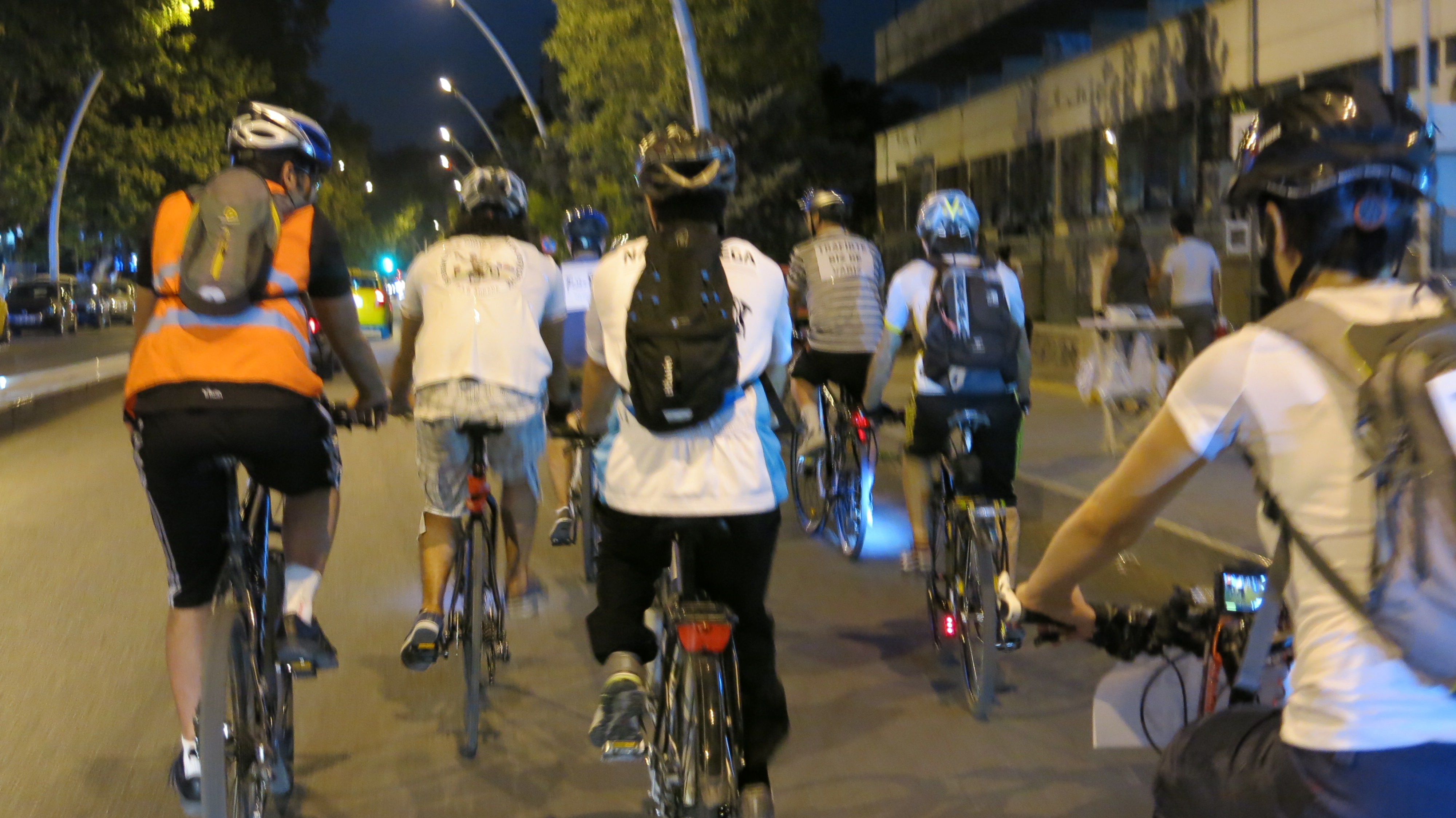
Along with my casual/normal riding, I also participated in a weekly group ride and witnessed a demonstration of the dangers of cycling.  Both events were influenced by the recent death of two cyclists, killed in separate incidences where attitudes and awareness of cycling in the motoring community were to blame.  It was an interesting experience for me to see these gatherings of cyclists in a city where I had struggled to see any presence of cycling.  My instant reaction to seeing everyone gathering for the group ride was glee.  It was great to see so many people caring about the conditions of cycling and other members of the cycling community, and for them to be taking the opportunity to ride together.  I liked that the group was showing the rest of the people on the road – walkers, drivers, bus catchers, everyone – that cycling was possible, it was something people were keen to do and most importantly our smiles showed that it could be fun.

IMG_9843

However, amongst the beauty of seeing so many people out on bikes together there was an emphasis on the dangers of cycling.  I could understand why they made the weekly group ride a memorial to the cyclists who had died and it was nice to show our respect while joining together to ride.  However, the demonstration which occurred the following Sunday made me feel ill-at-ease.   There was a theatrical performance in the park which involved people lying down pretending to be dead and injured.  Everyone who joined the demonstration were told to wear black and show sombre faces (no smiling or laughing).  I tried to gather what messages would come form such a demonstration.  There was a great turnout of people, so the first message was a support for cycling and the improvement of cycling infrastructure and culture to reduce the dangers of cycling.  But amongst this, I cannot help but feel that this demonstration was increasing the sense of fear the community has to cycling and reducing the images of fun and freedom that are part of the psyche of almost everyone I have met who rides in any city in the world.

So, I guess a starting point for community demonstrations about cycling should be what messages need to be portrayed to politicians, bureaucrats, people already cycling and the community at large.  Ankara has a huge way to go to make the streets safe and fun for everyone to ride but is it responsible to emphasise danger and give people a reason to fear cycling?  I think the importance of improved infrastructure needs to be in the minds of the bureaucrats, the economic, social and environmental benefits of cycling need to be drilled into the heads of the politicians and the community need to see that cyclists are humans like everyone else.  Everyone in the city of Ankara has to believe that they could one day ride in their city, and that when they are using the streets they should be looking after everyone that is sharing it with them, including cyclists.  These are just my thoughts – I know it’s a tough moment – when drastic changes are needed and cycling is such a marginal form of transport, that it seems easier to ignore it, but once things turn around and the momentum starts, I think it will be so worth it!

In my spare time over the next couple of months, I would love to be involved in developing a cycling strategy for this city.  If anyone has any information or ideas to help me, please get in contact.  Let’s see what we can do.

Ankara – a planned city with lots of different directions

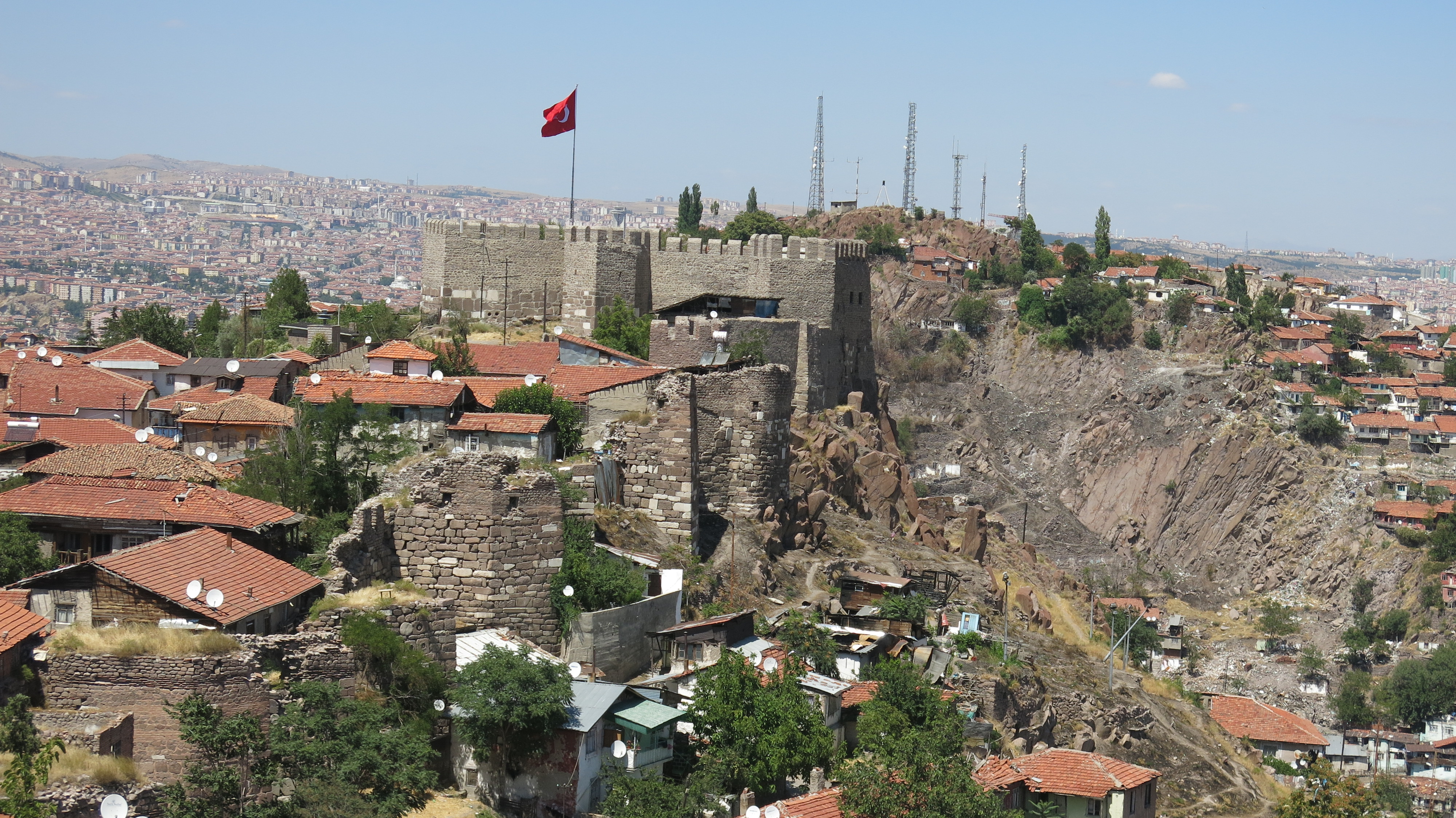
So, my approach to ankara involved a few days in istanbul and a couple on the aegean coast and everyone I met kept warning me about how boring Ankara was.  ‘It’s just a capital city with lots of public servants, it’s a planned city with no history’.  I kept thinking about canberra.  But worse than canberra they said no one rides bicycles in Ankara.  I was starting to feel a little reluctant to get the overnight bus to a place which had ‘car’ in it’s name.  But boring cities can still have interesting transport, and everything is relative – a city in turkey with no history still has castles and turkish baths and museums.

IMG_9229

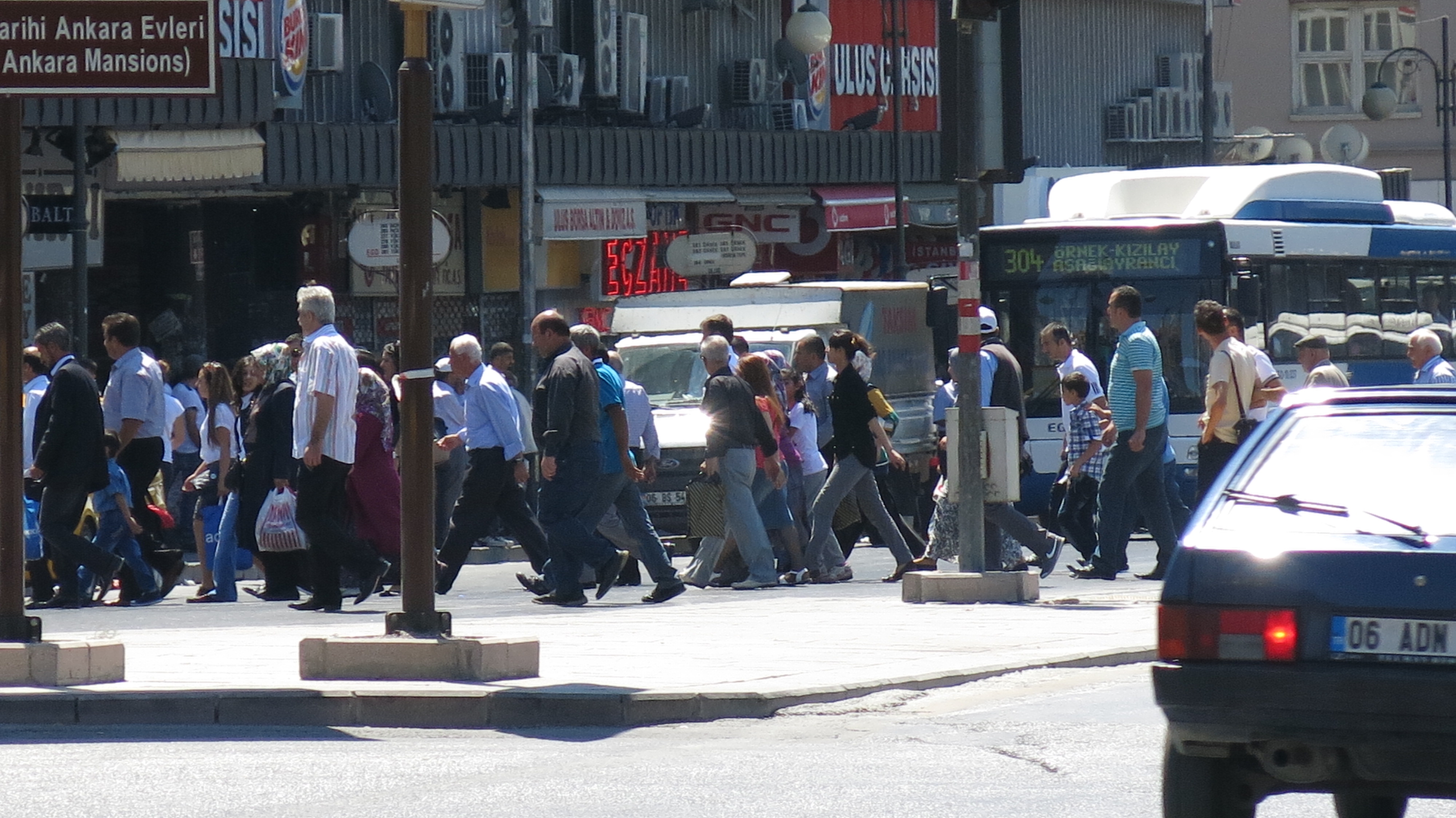
I have now spent a few days in Ankara – it’s the first city of my project with a metro system, but sadly it seems to be lacking a bicycle presence.  It’s a lively city with lots of pedestrians.  There are overhead pedestrian walkways to cross roads, wide footpaths and some pedestrian malls in the centre of the city that are teaming with people.  Having said this, locals complain that not all the pedestrian infrastructure has been well allocated.  I don’t know about this, but I know the council of Ankara likes spending money on things like colourful fluorescent lights in trees and benches in the median strip of a highway (which can come in handy when you have been standing and waiting for a gap in the traffic I guess but not really where I’d want to spend my Sundays).  But however they are catered for, the pedestrians are definitely a force in Ankara.  They have a way of crossing the road which surpasses all others I have seen.  They just go for it, whether the there is a green man (oh, they have awesome animated green men here) or red man, if there is enough of them, they just take on the cars and cause traffic to back up for miles as they refuse the cars entry to the intersection.

IMG_9412

The pedestrians and public transport (buses and dolmuses – the turkish equivalent of a matatu) interact freely, with people getting on and off dolmuses (and sometimes buses) anywhere along the road.  The dolmuses will beep at pedestrians to see if they want a ride and they will jump around the lanes to get to a potential customer.  While the traffic isn’t as chaotic as India, the lane structure can certainly be interesting at times, and dolmuses have a way of weaving their rather large derrieres through all sorts of gaps.  Buses can be quite full at times but I have been luck enough to catch the less crowded buses of the ramadan holiday time.  Now traffic is back in full swing I will have to try and my luck on some more crowded transport.

IMG_9250

However, I have just made my most significant purchase in a long time and I want to make the most of it.  I bought a brand new bicycle.  The reasons are as follows:

  • I want to have good control to face the traffic of Ankara
  • I have only seen one other girl riding a bicycle in Ankara so it’s important to show that cycling can be fun and slightly stylish
  • Most bicycles sold are children’s bikes or mountain bikes and we have to start getting the bike shops interested in marketing to commuting cyclists.
  • I want to have fun and feel good on my bicycle even when facing the hills of Ankara (which I didn’t find too many of today but the locals keep telling me it’s a hilly city)
  • It’s my birthday on Thursday and there is a group ride and I want it to be fun

IMG_9452

Ok, so I have a bicycle and I’ve attacked the traffic.  No one on the road is expecting you, so being careful of car doors and swerving vehicles is key for survival.  On my ride I couldn’t help but want to give this city some cycling infrastructure or at least a map to help people get through this town.  There are wide footpaths in some areas which could be converted to shared paths, there are spare bits of road in other areas that is currently doing nothing (except when a dolmus tries to squeeze through), there are lots of areas without parked cars, where a bicycle lane could fit.  I also don’t think the hills are that bad, the weather seems nice enough and I’ve seen much worse traffic in my time.  I feel like Ankara is crying out for someone to start a cycling revolution here.  It’s filled with university students and public servants – the same kind of people that are riding everyday in Canberra.  So the plan is to try and plant some seeds in people’s head by getting out and riding this city with a smile for a week.  I might even try and make my own map of different routes as I get better at knowing where I’m going and knowing the quieter ways to go.

It’s time we talked about matatus

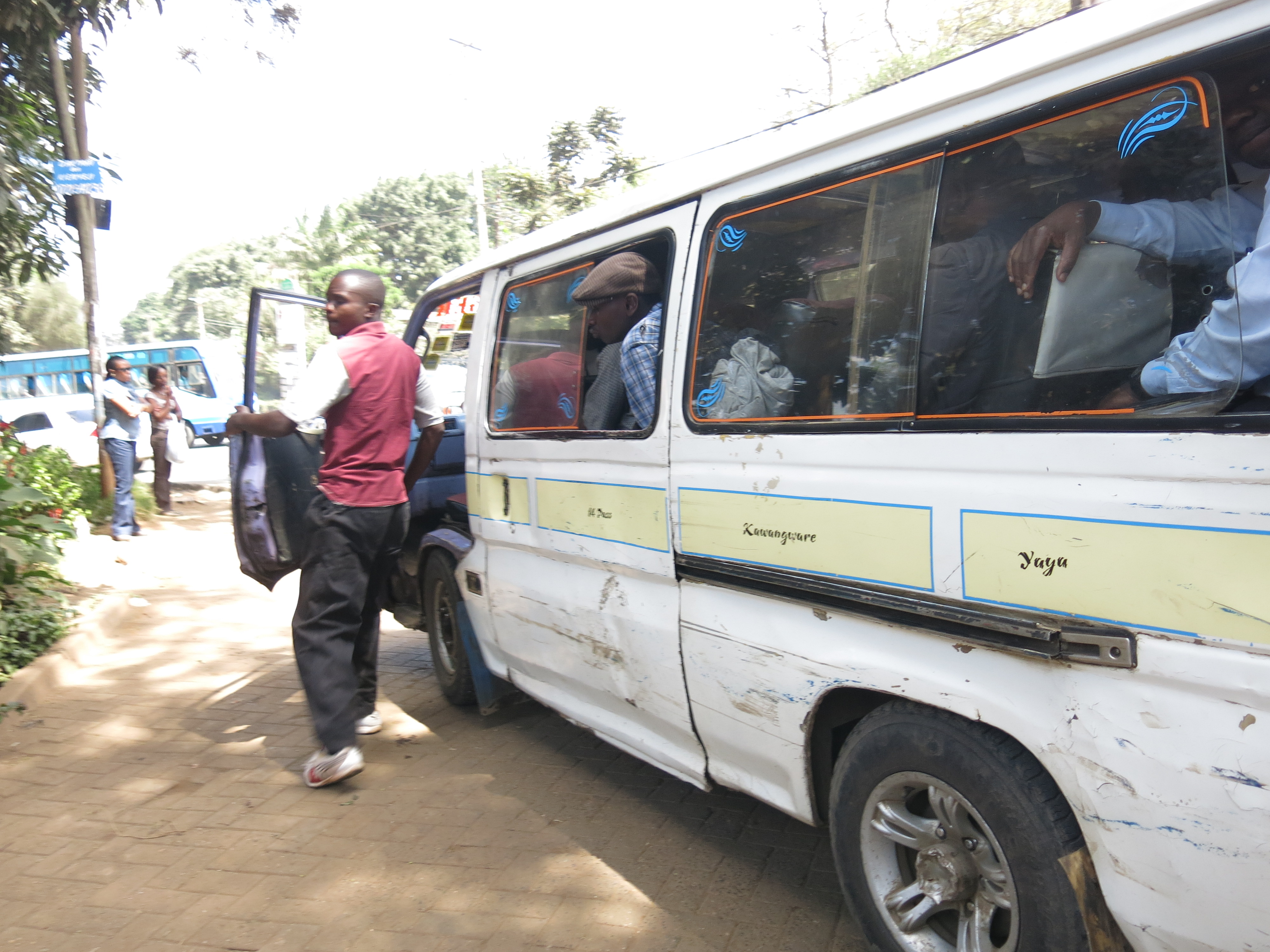
So I’ve briefly mentioned matatus throughout my discussions on nairobi, but they deserve more attention than that.  Matatus are such a part of the culture of nairobi and were part of the reason I became interested in the culture around urban transport all those many years ago.  Matatus have such a strong culture around them that it is one of the biggest barriers to introducing any other forms of public transport.  Some people are proud this culture, others less so, but everyone knows it’s there.

IMG_7100

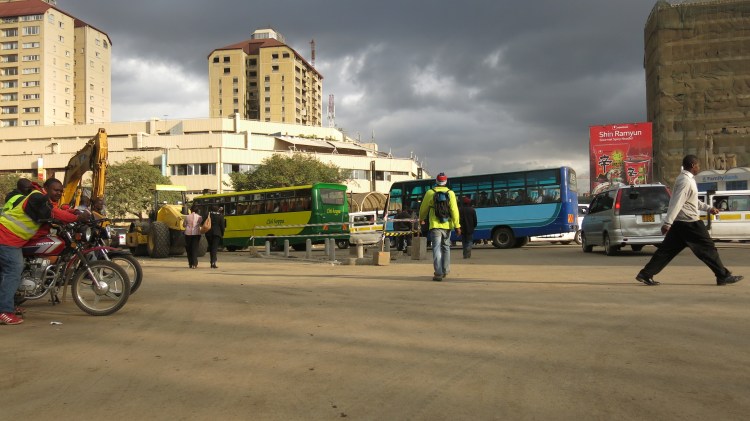
First of all, what is a matatu?  Some refer to all buses and vans used for public transport as matatus while others look at it more like goldilocks.  There are the big buses, which are too big to be called matatus and are hence called ‘buses’ (surprise surprise), there are minivans that are too small to be called matatus and are hence called ‘nissans’ (they are all secondhand or maybe thirdhand from japan) and then there are the colourful vehicles which are just the right size to be called matatus and they are hence called ‘matatus’.

IMG_7211

Buses have set stops (or stages as they are called in Nairobi).  So you wait, get on, find a seat and then the conductor comes around to collect your money, give you a ticket, and turn the funny contraption that looks like it’s come from a world where bigger and heavier machines were the bomb.  The bus is filled with seats and the idea of standing is left to people hunching is minivans in rural areas.  In most of the buses I caught, the atmosphere was quiet, there was occasional music and there was even sometimes people getting on the bus to sell their wares.

IMG_7158

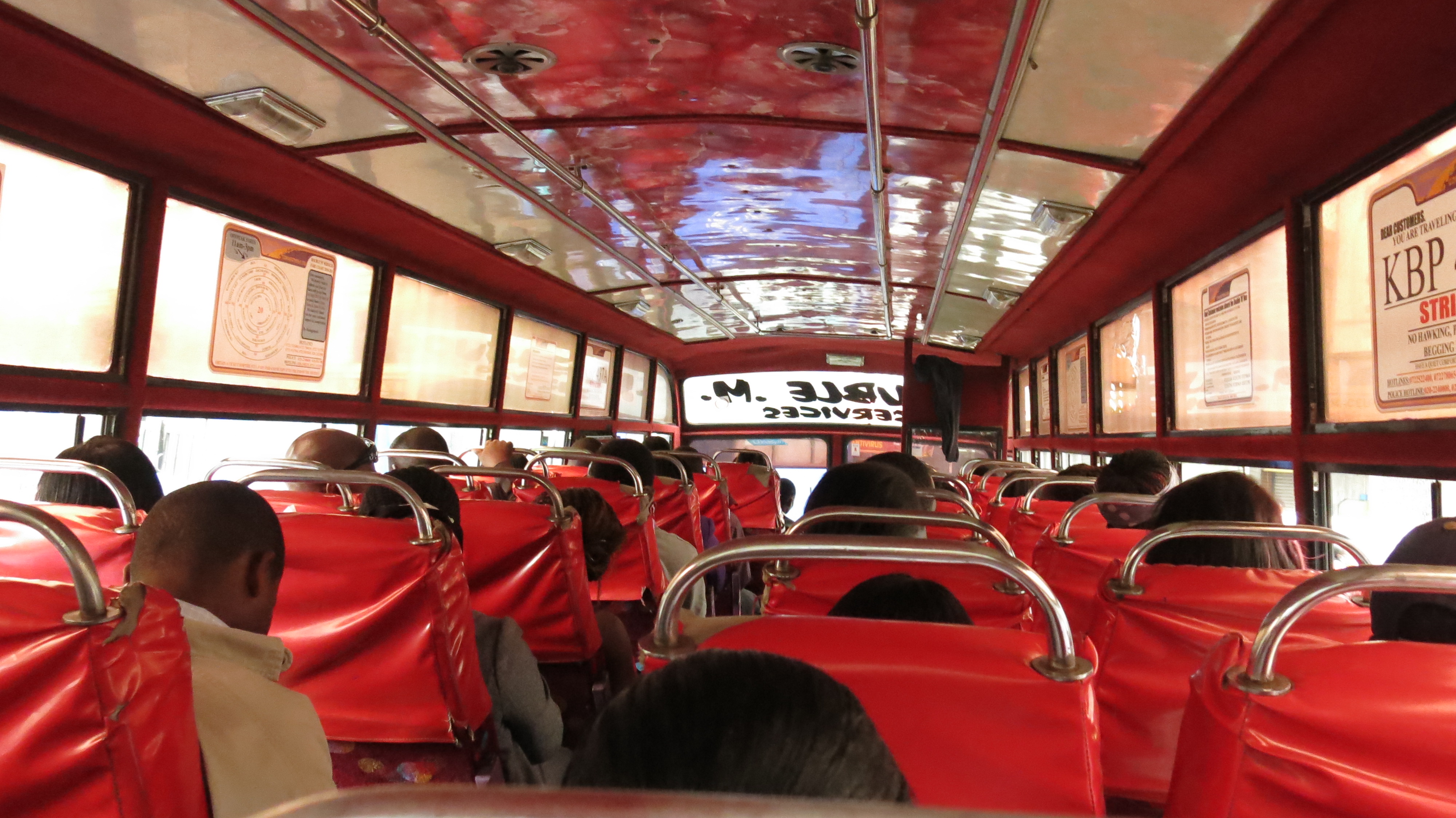
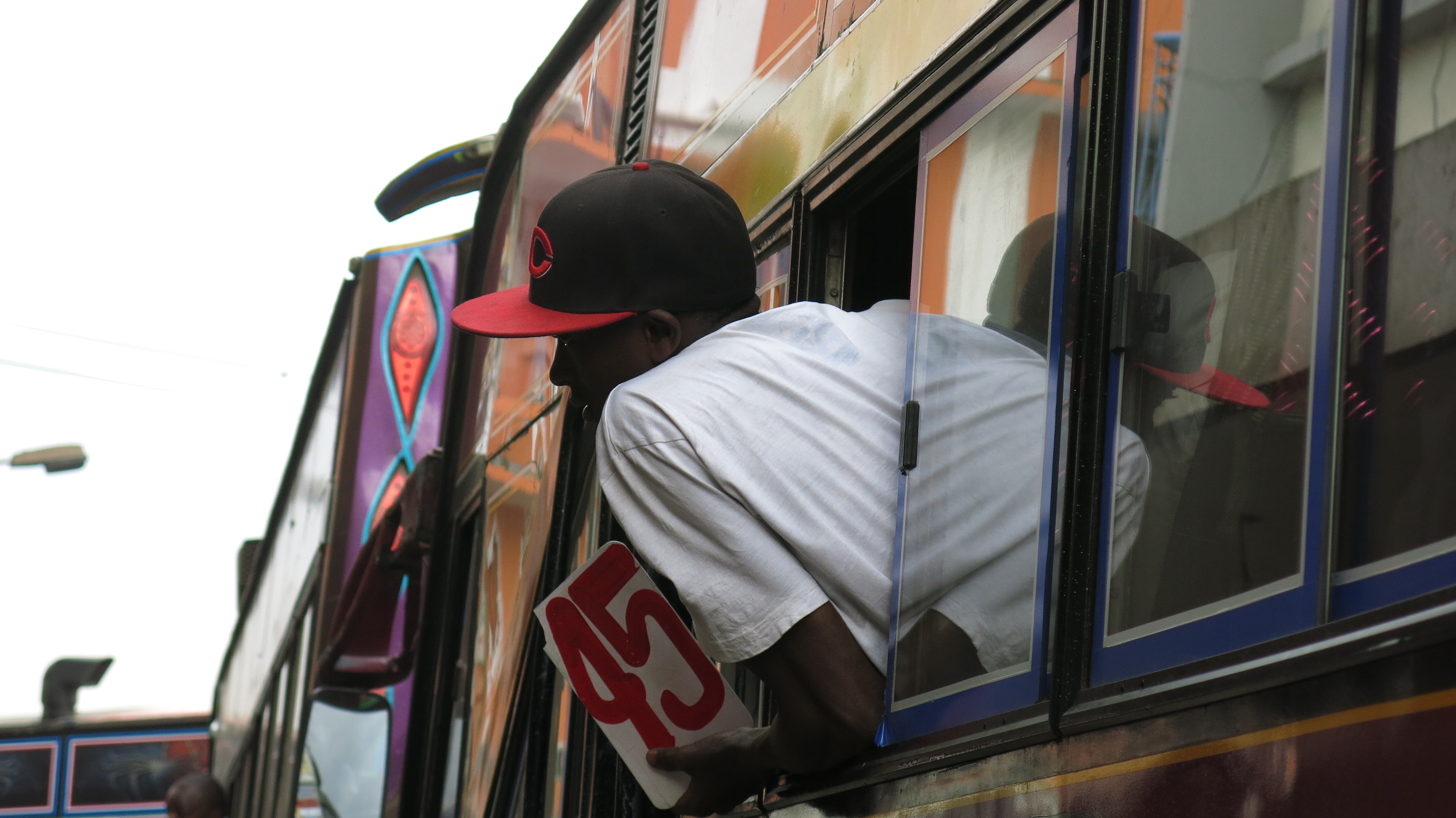
On matatus and nissans the ambience can vary drastically.  There are those for business people that are quiet and serious.  Some people talk I guess, or look at their phones, maybe listen to their own music.  Then their are the matatus that are designed for particular audiences such as students.  Here, noise is essential – and if there is a beat with so much base you can’t feel the bumps in the road – you know it’s going to attract the customers.  People don’t just hop onto any matatu and the touts see that they make enough noise (they call it welcoming to whistle and yell at you) to ensure you choose the matatu they are touting for.  So a matatu stage becomes a bit of a stage as the touts perform their acts of persuasion.  Once you have clambered in, you might be waiting for the tout to fill up the vehicle before you go or if you’re lucky it is almost full (full one meant there was no excess air in the matatu, but now it just means the seats are filled up).

IMG_6965

When the music is loud, you cannot talk to anyone unless you shout and everyone just bobs up and down to the music – there are often cushioned roofs – I guess that’s for if your bobbing becomes extreme.  The decorations can mesmerise you for a while – with posters of rappers and general bling lining the walls of the matatus in all sorts of colours.  These decorations and music are more than a way to attract customers, they are an important form of expressions with nairobi, with every nairobi driver taking pride in their vehicle.

IMG_7403

I guess at the end of the day, what is so interesting about matatus is what they represent to the people of the city.  Even when they are dangerous and loud, they still have a place in the hearts of the people of Nairobi.  They are seen as part of the fabric of the city.  I guess this is an important part of any transport system and something I’m searching for in cities around the world.

A diversion

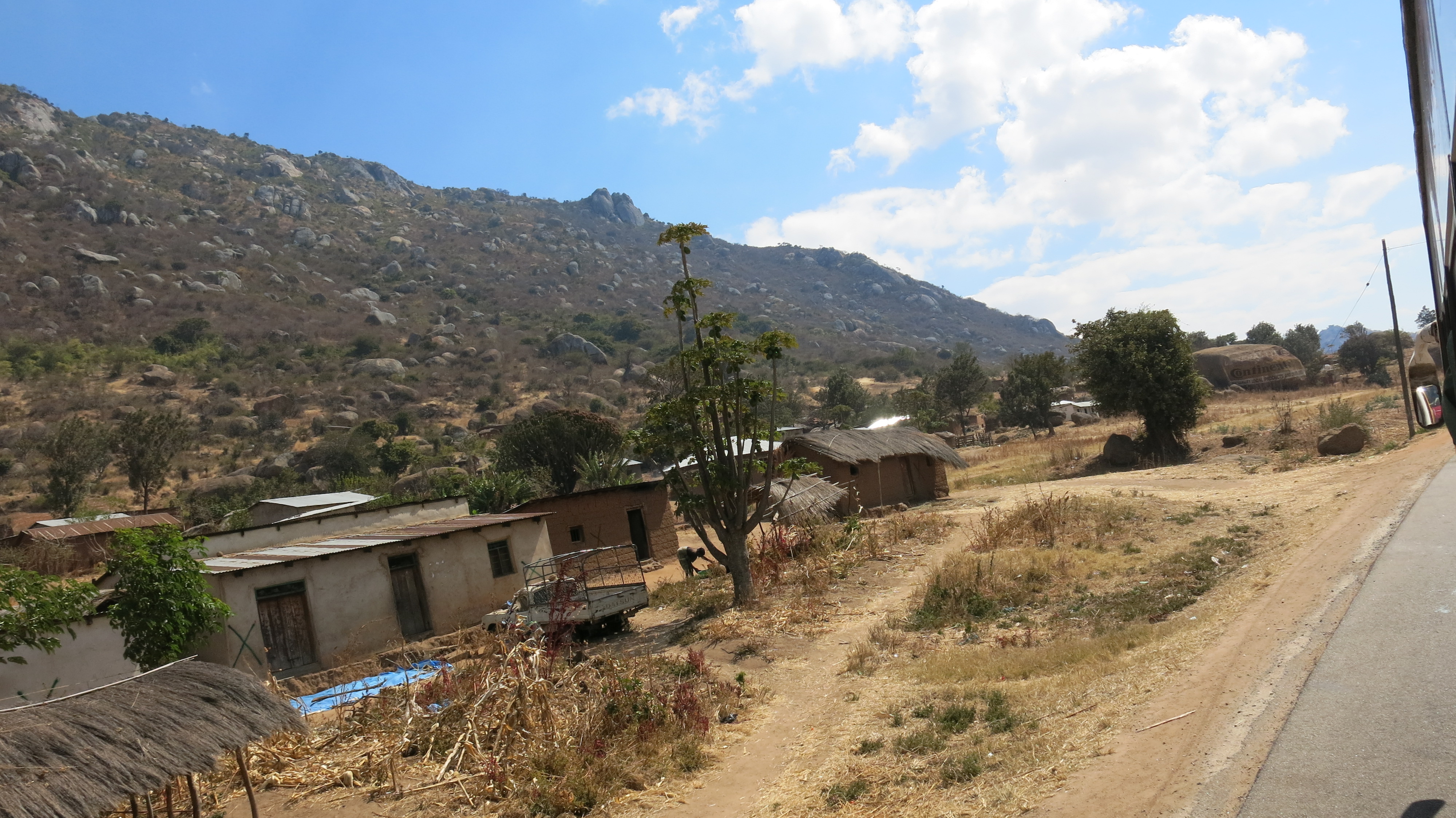
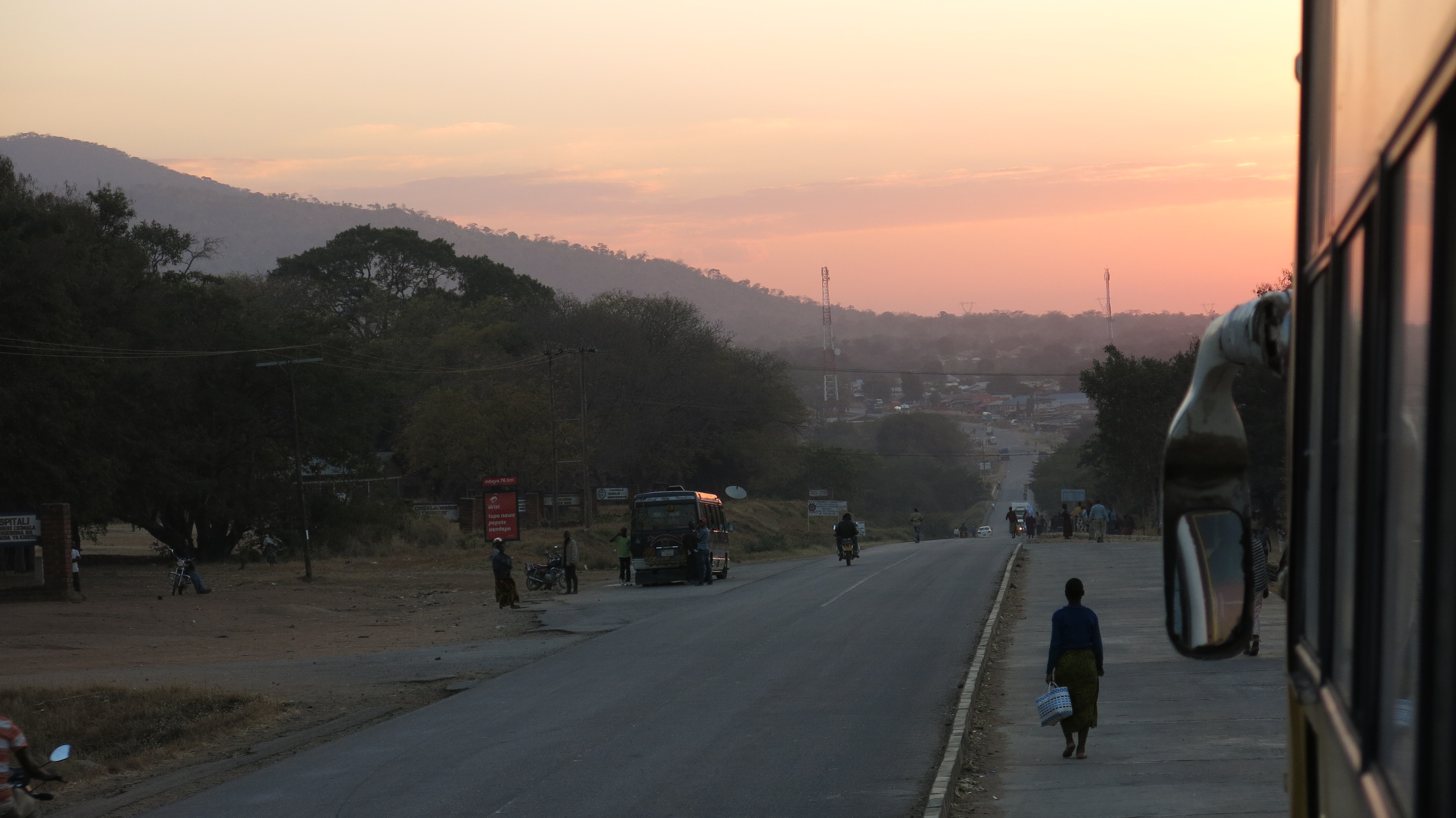
I spent a couple of weeks away from Nairobi to explore some of the more remote areas of africa and the transport that goes through them.  I travelled to the coast on a train.  Then by buses and minibuses to Malawi.  I actually met people along the way who said ‘what about rural transport’ when I told them of my interest in urban transport.  And to some extent, I guess I have tried to focus on the complex, dense systems of transport that are part of city life, but at the expense of the challenges , beauty and community that are part of traveling around rural areas.

IMG_7667

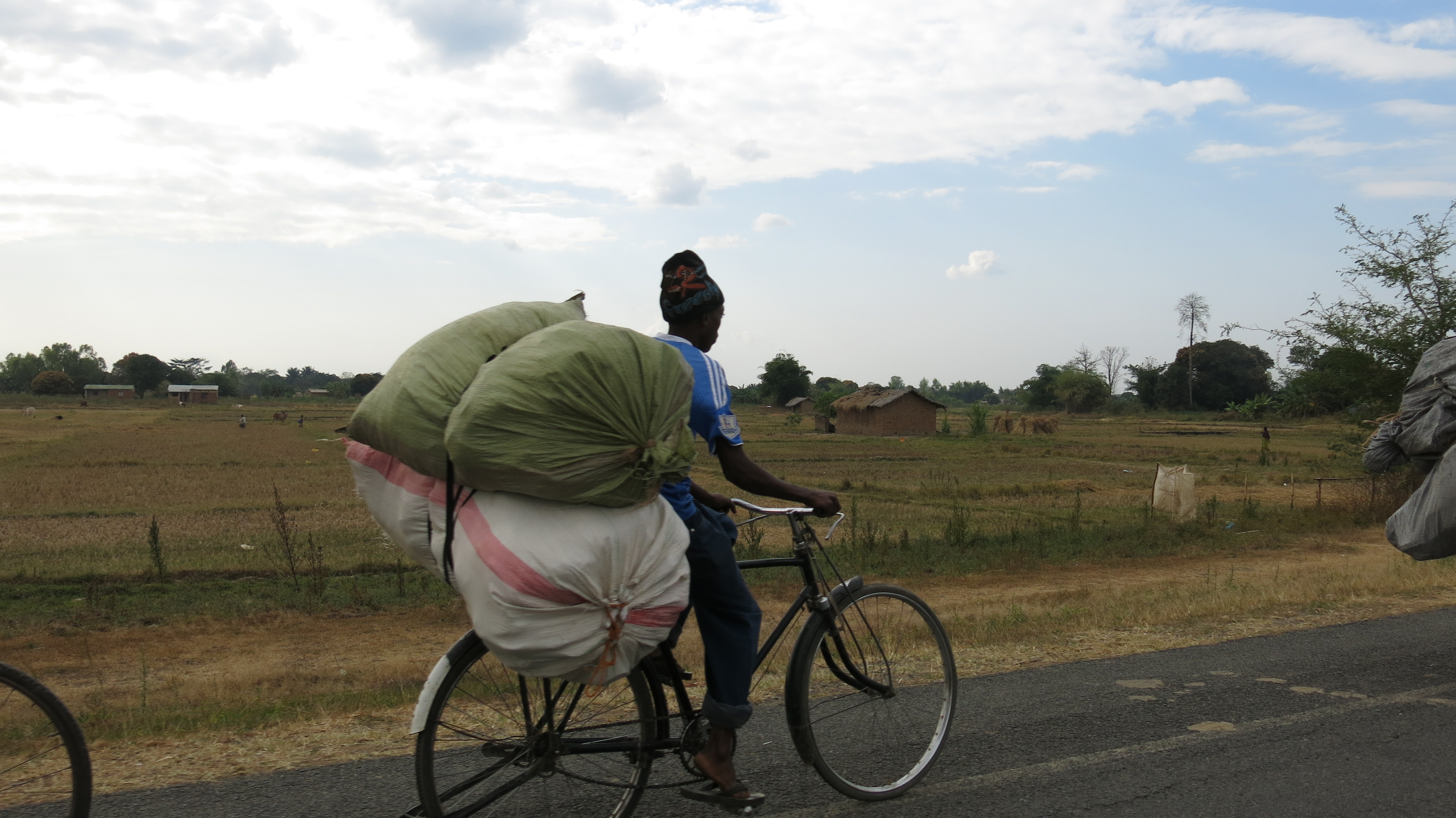
While in Australia, individual motorised transport is seen as a necessary part of rural life (and I guess one use of cars that I consider warranted), in Africa this is not an option for most of the rural population.   Therefore they rely on public transport (mainly minibuses) and active transport such as walking and cycling.  In rural environments where distances are long and populations are spread out, this can make transport a challenge for many.  Hours of people’s days will be consumed to wait for minibuses to fill up (because in africa they are all about maximises the profit per trip made, no matter how much waiting this means), and other people will expend energy walking and cycling far to work or the shops, maybe carrying loads as well.   I was also informed that the costs are higher than minibuses in the cities for the same distances.

IMG_8075

But amongst all this hardship and expense, there was a definite sense of community and fun – more than I had seen in any city I have visited.  In the middle of the night, two hours north of the border crossing from tanzania to malawi, I felt like I was in a rowdy crowded pub as I entered the minibus and managed to grab one of the last remained ‘seats’.  Seats is in brackets because you are given a proportion of the space that was designed for one persons backside – if you are lucky you are sharing four seats between five people, but this is not considered economical by the driver.  Headed for a place I thought I knew how to pronounce, this bus kept filling up until there were about fifty people on a bus designed for about twenty or so.  I was the only white person amongst them and the only one that didn’t understand the kiswahilli banter that took place between the tout and one of the passengers.  There was cheering and jeering, and sometimes I would start laughing just to fit in.   The jist of the conversation was the passenger complaining about the number of people on the bus and demanding a ticket.  The tout asked what name he should write and he was told to write ‘my husband’.  This was considered very funny.  East africa is the most homophobic place I’ve been to, so this joke would have been considered funnier with this in mind I guess.  Anyway, apart from being homophobic, these rural folk were very welcoming to my straight little self, and while I found out the bus wasn’t going to where I wanted to go to, everyone was out to help.  I ended up sleeping the night in a guest house with another girl who was also heading to kyela (in the same bed :P), before continuing my journey the next day.

IMG_8117

People didn’t just talk amongst themselves, they also talked to me.  Taking the opportunity to exercise their english and inflict their views of religion, family values and economy issues on me, I partook in a range of conversations.  Of course there were marriage proposals too but there were also some interesting ideas and concerns that were raised.  I enjoyed the company and the opportunity to feel a part of the community as people would tell me to come and visit them the next time I was in the area.

IMG_8158

Personal space is not given much consideration in rural transport.  I was thigh to thigh with many different bodies, sometimes with a slight overlap where necessary.  This was not considered sensual or particularly uncomfortable, just part of life.  On more than one occasion I also found myself with another ladies child on my lap.  It was nice to know that people trusted a funny looking white girl with their progeny and I enjoyed the company (it may even have made me think more about having children myself – but don’t tell my mum this).  While I did lose feeling in limbs form time to time, and performed interesting yoga moves to get in and out, overall I felt at peace in these minibuses.  I did feel sorry for the guys who were constantly bent over, and I can imagine a certain hunch could develop in the genes of these africans.

IMG_8420

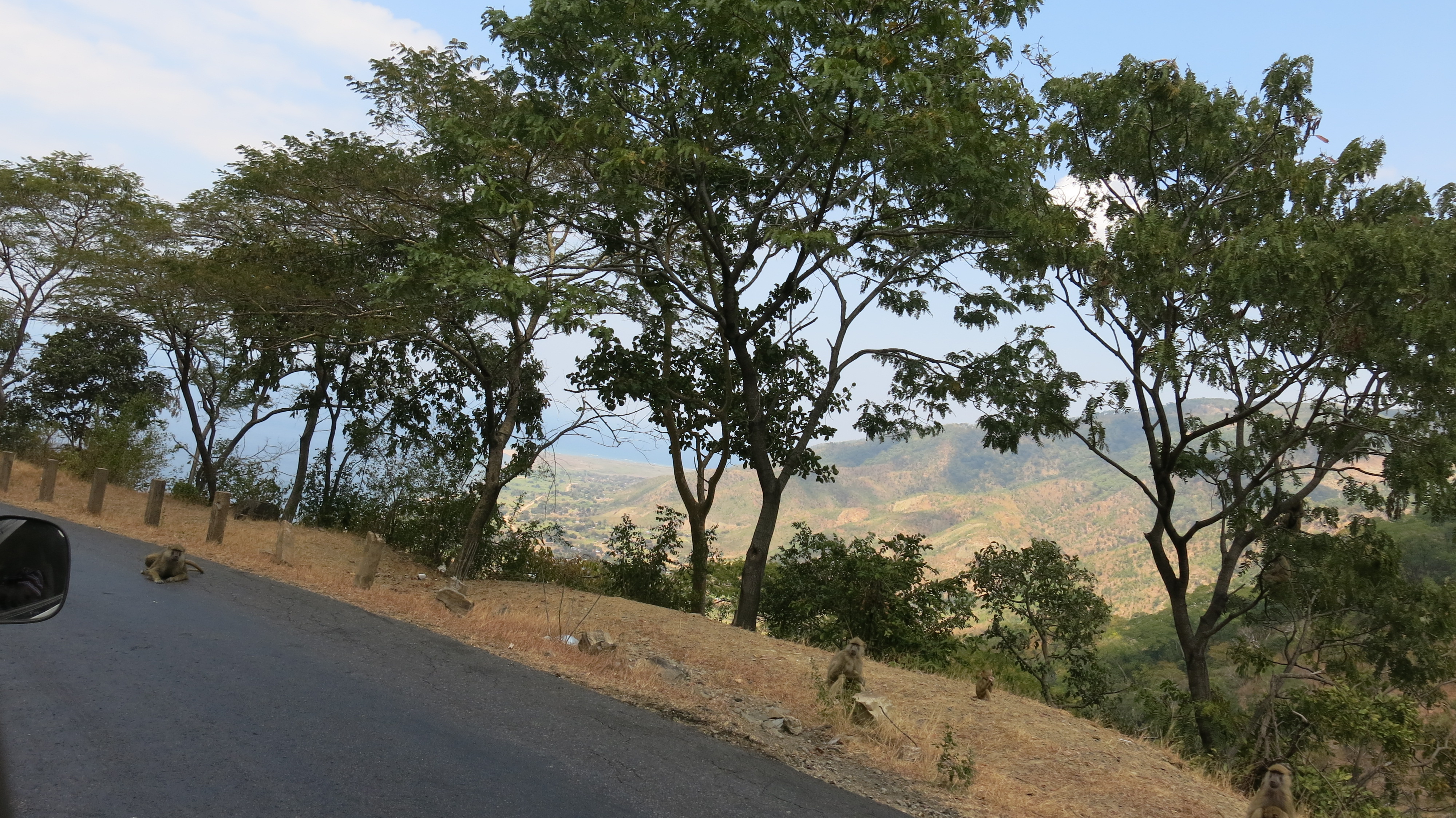
I saw some beautiful country and witnessed which regions grow what crops.  My traveling companions would tell me about the agriculture in the region, I would see it being grown and then as we pulled in to a bus stop, the windows would be ambushed by people with trays trying to sell you the produce from the area.  It was nice to see all stages of the process from the bus.  I would end up with kilos of bananas rather than the couple I wanted but it cost less than one banana in Australia so I wasn’t too worried and I could offer them around.  On my long distance bus rides I also got to witness giraffes, impala, baboons and monkeys.  It was kind of nice to not have to go on a safari and look for the animals but just get to see them by chance – like seeing cool street art rather than having to spend money and time to go to an art gallery.

IMG_8597

Well now I’m back in the city – one more day til I leave kenya.  I think my experience in rural africa has given me fresh eyes and attitude to the streets of nairobi.  Yesterday I went and talked to matatu drivers, filmed along streets I’m usually scared to walk down and I even had a go at touting – ‘harumi, harumi – 60 shillings … bang bang on the minibus’ and I managed to fill up the bus fast :).

IMG_8750

It’s a medley day of transport

Yesterday started off as any other day … breakfast with a dash of yoga (my style of yoga is kinda more for the attention deficit amongst us so I’m not sure it is very yogic).   Then I had the keys to the lock of my friends bicycle – and this meant it was cycling around nairobi time.  And then suddenly my go pro started working again (my go pro saga has involved every permutation of turning buttons on and off, taking batteries and sim cards out, plugging it into the computer, reformatting and updating stuff – oh, and going on a go pro hunt through the shops of nairobi).

So, with a camera stuck on my head I headed out on the road, with my single speed, back pedal braking bicycle.  And it was fun!!!  I can’t believe how much joy riding a bicycle gives me.   Because I’m not riding everyday I think I’m appreciating each ride a little more.  I glided through intersections, trying not to stop because I hate starting when I have a fiddly back pedal brake to deal with (I don’t know how I’d cope on a fixie) and I spun my legs as fast as they could go.  I had many smiles and workers on the side of the road were asking me to give them a lift.  I felt as free as I have felt in nairobi.  I went along random little roads until I thought I would be testing my backwardsI will go for another ride soon and make sure I show you some of the footage in my film.

IMG_6781

Next, was a walk to the shops – this involves some dubious road crossings and walking on half constructed footpaths with fumes from buses seemingly designed to be directed straight at the pedestrians – this could be a deliberate attempt to make people want to get off the footpath and onto the buses.  But I never feel alone on the street as there are always people walking somewhere nearby and there are often people gathered on corners – either boda boda drivers, people preaching to each other (btw preaching s forbidden on buses in kenya), and micro stalls – where a lady has a stock of 10 bananas, 20 tomatoes, a few avocados and maybe a giant mango.

So, after my walk fighting the buses, I found myself on one.  I sat there in silence just observing the various buildings, trees and skies that were outside the window.  I also noticed that everyone else was doing the same.  In Kenya everyone is seated on the bus.  It might be that you have to find ways to offset your shoulders and hips so that you can all fit on the seat (in a similar way you do when you put four people in the backseat of a car) but in one way or another you all have a seat.  It is fun to watch everyone’s head bob up and down as you look across the tops of the seats – there is almost something tranquil about it.  Perhaps the fact they are bobbing indicates the bus is moving and this is an exciting thing for a bus in the streets of nairobi which a jam packed full of traffic jams.

IMG_6736

From bus to matatu – the major difference is that they are smaller in size and the guy hanging out the doorway is more intense in his search for passengers and the driver seems more intent on not fully stopping the vehicles for passengers to alight.  It is all about walking/running at the same pace as the bus at the moment you get on or off the vehicle.  Matatus are also more colourful and decorated and a bit quirkier in shape.  But at the end of the day you just sit there on the chairs that have material which might have come from your grandparents old carpet and you bob up and down – some matatus have soft ceilings for those extra big bops of your head.  They also have lots of stickings and signs with references to god and the fact he is in control and will take care of us – trying to provide comfort to passengers who aren’t too sure the driving is having any control.

IMG_6952

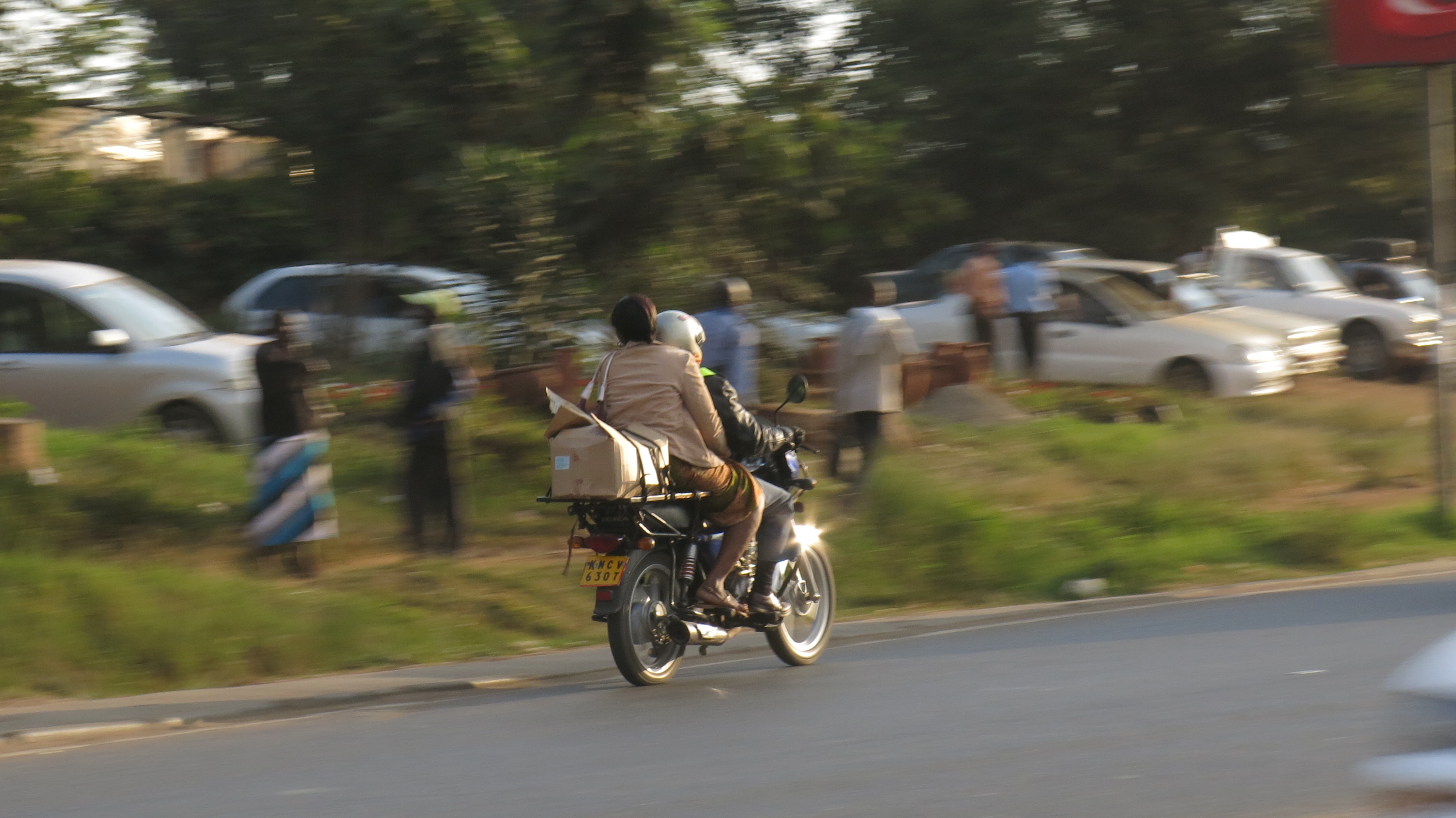
So all these different ways of getting around was working my way up to a boda boda ride.  This is a motor bike taxi, where you are sometimes given a reflective vest and an oversized helmet to provide you with fake security.  Then you jump on the back of a bike and he takes you through the fastest and most interesting shortcuts possible as if you need to get to a bomb site to disarm the bomb and save the city.  We went through puddles, up little mounds, along something of a footpath, through tiny gaps that put bike couriers to shame, and of course along a road that isn’t open yet so you have to pass through a petrol station and up and down ‘gutters’ to pass the various obstacles that are trying to stop the superhero style driver from getting where he needs to go.  And then he stops at a random stall at a market and while I sit there wondering if he is going to dump me there, he is just doing some business before carrying on his way.  I made it safely home.  So that was almost a medley of transport in nairobi – I missed out on catching a taxi or being in a car.

It’s in the way they walk

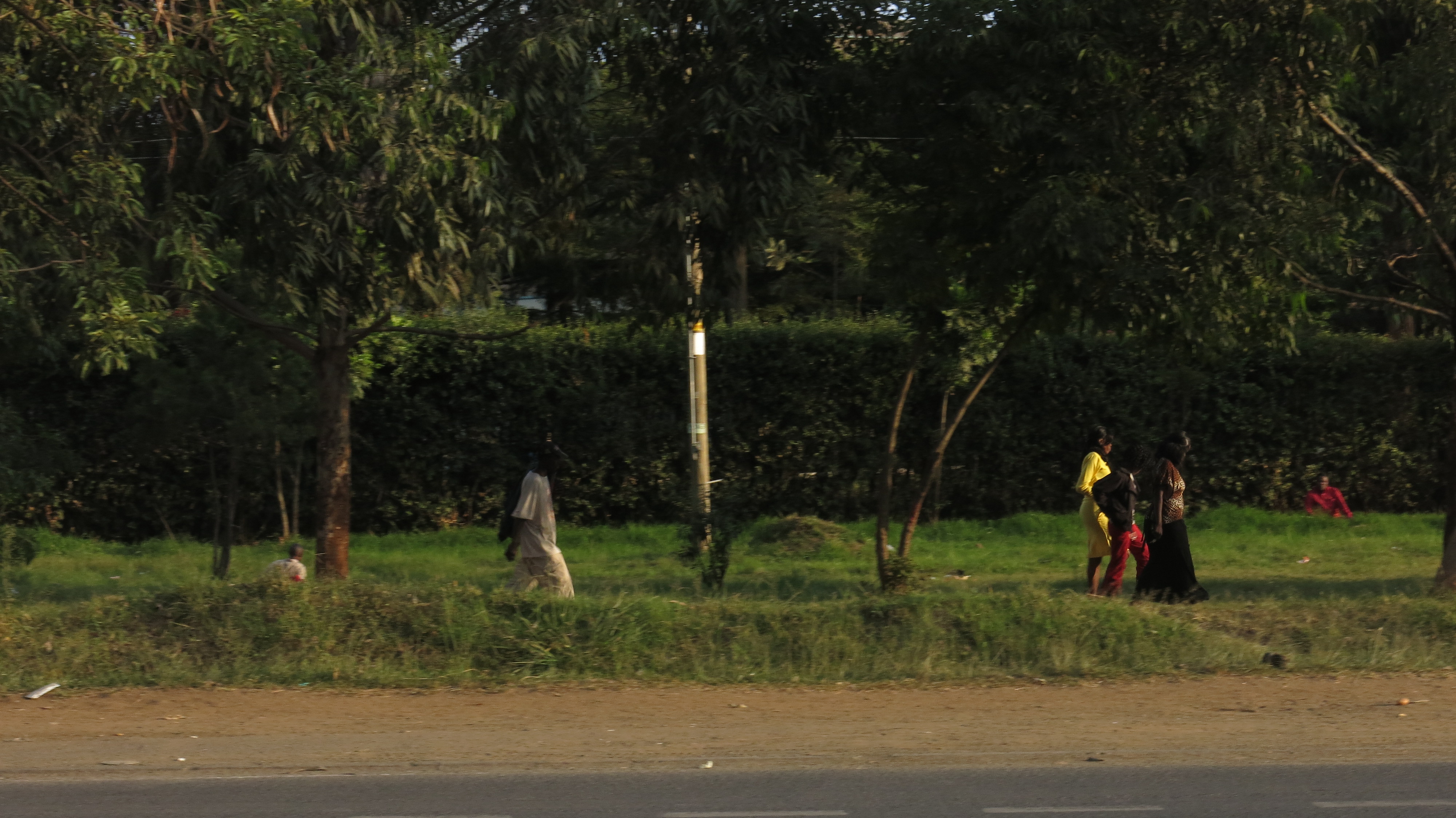
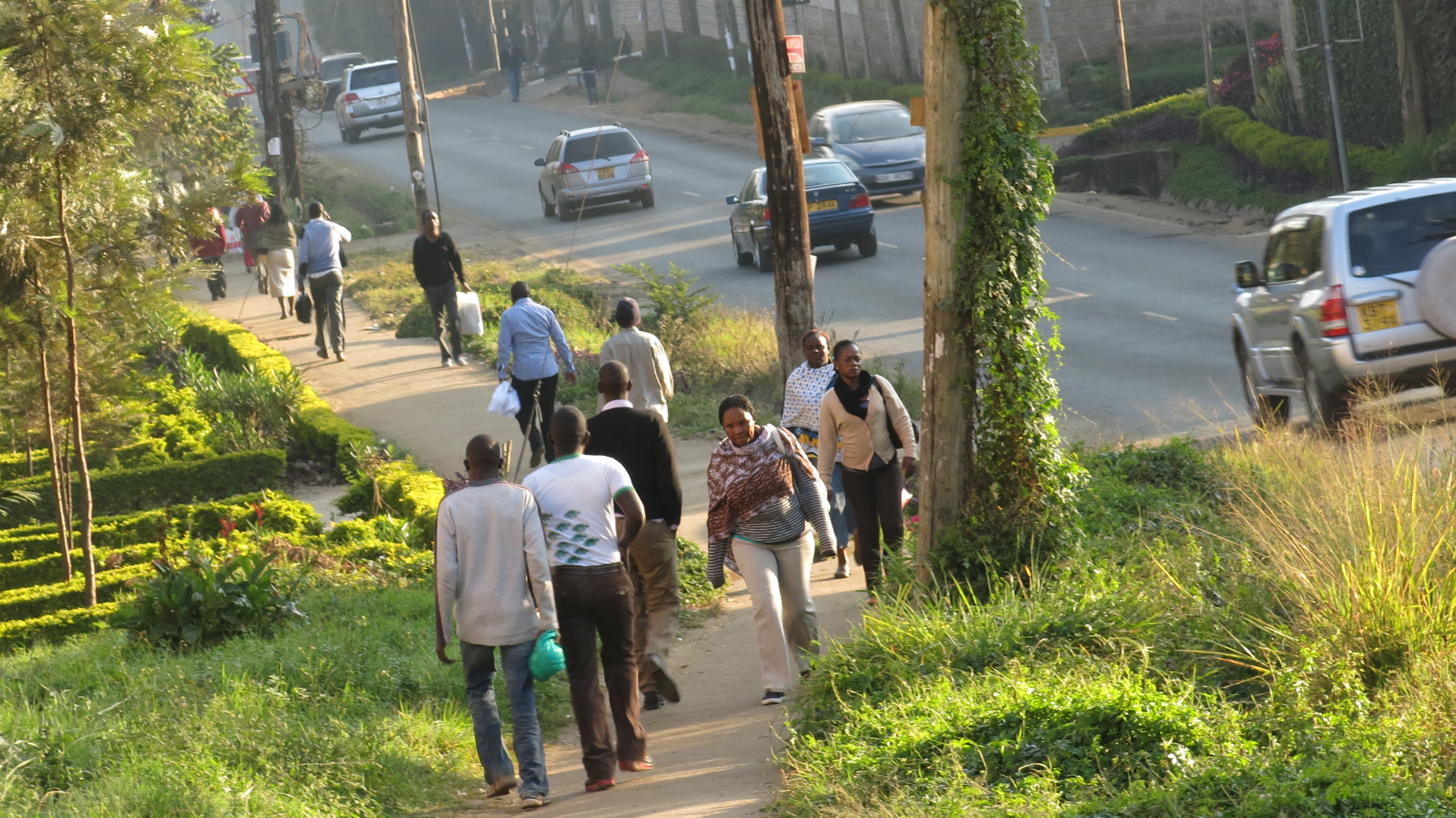
People have been walking to some extent in every city I have visited.  I always enjoy seeing people on the streets and it is nice to see them move along one foot in front of the other, in their own little rhythm.  But until now I have never thought too much about how they walk and the beat, the bounce and the attitude that a walk can give to the street.  From my taxi on the way to Nairobi I became captivated by the way the Kenyans were walking.  They were making otherwise dull streets have movement and colour that almost made you want to dance yourself.  It felt like a small step between the movement I was watching to a street party where everyone was getting into the groove.

IMG_6957

Once I got out on the street myself I couldn’t help but hope that this walk was contagious and I was somehow walking with flare.  Well, I definitely felt more fun and alive while I was walking.  I tried to have a bit of attitude but then I just felt like I was kidding myself and I break out in an internal giggle that definitely portrays no style at all.  While I don’t have much gangster or catwalk style about me, I thought my relatively large bum might make up for it, but I just feel ridiculous when I try.  I am hoping that I am acquiring the walk gradually without thinking about it (like one might acquire and accent) and when I come back I will have a walk that will make people.

IMG_6912

Yesterday I took a local up on an offer to go for a walk around a slum.  This involved walking in all sorts of conditions, without footpaths, through dusty roads and paths, along a railway track which dictates the length of your stride and then across puddles that I tried to avoid contemplating the contents of.  We walked constantly and I tried not to be tired but I felt like collapsing at the end of it. I just didn’t have the stamina of the kenyans (and we are at altitude).  On my way I was stuck in a matatu in a traffic jam.  A small voice in my head was saying that getting out and walking would be faster but then a much more dominant voice told me to sit where I was and enjoying slipping in and out of sleep as the bus lurched two metres forward and then sat idle for a few minutes.